Vermont · seasonal outlook
Vermont Fall Foliage Tracker
Vermont's colour does not sweep across the state — it comes down the Green Mountains. The Northeast Kingdom turns first, the spine follows, and the Champlain and Connecticut valleys finish last, which means two places at the same latitude can be a week apart.
Region-by-region timing · estimated from historical phenology, not live imagery
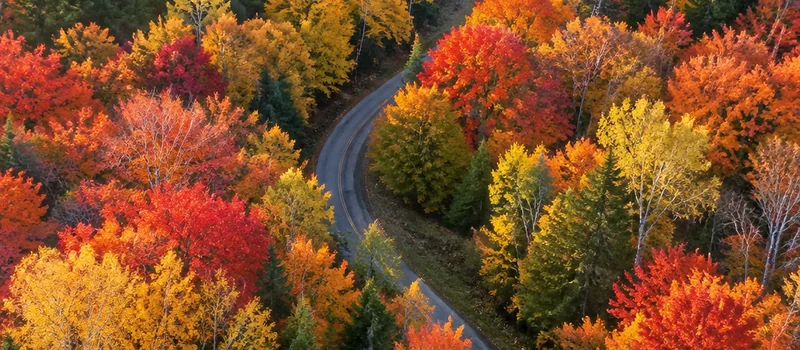
When Vermont turns, region by region
| Region | Typical peak | Road to drive |
|---|---|---|
| Northeast Kingdom (Essex, Orleans, Caledonia counties) | late Sep | Vermont Highway 100, the Green Mountain Byway |
| Northern Green Mountains and the gaps | early Oct | Vermont Highway 108 through Smugglers' Notch |
| Central Green Mountains (Sugarbush, Killington) | early–mid Oct | Vermont Highway 17 through the Appalachian Gap |
| Champlain Valley | mid Oct | The Middlebury and Roxbury gaps |
| Southern Vermont and the Connecticut River valley | mid–late Oct | Vermont Highway 9, the Molly Stark Trail |
What this state's colour is made of
Sugar maple
Vermont's state tree and the reason its red is unusually saturated. Sugar maple produces the most reliable scarlet of any eastern hardwood, and here it covers large areas as the dominant species.
Red maple
Earlier and duller than sugar maple; it fills the wet ground and softens the edges of the season at both ends.
Yellow birch
The bronze-gold layer beneath the maples, and a large part of why a Vermont hillside reads as three colours at once rather than one.
American beech
Holds its leaves into winter, so it is the tree still rustling in December after everything else has dropped.
Eastern white pine and hemlock
The dark ground the hardwood turns against; without them the colour would have nothing to sit on.
What is specific to Vermont
Fact 1
Vermont's red is a species effect, not a climate effect. Sugar maple produces the most consistent scarlet of any eastern hardwood, and it is the dominant tree over large parts of the state. That is the difference between Vermont and a state where red maple does most of the work — red maple turns duller and earlier.
Fact 2
The Green Mountains run north to south, so colour advances down the spine rather than sweeping west to east. Two towns at the same latitude can be a week apart if one sits on the mountain and the other sits in the Champlain or Connecticut valley.
Fact 3
The gap roads are the exception worth planning around. Smugglers' Notch, the Appalachian Gap and Middlebury Gap all funnel cold air through narrow passes, so their hardwood stands often turn several days ahead of the valleys on either side of them.
Fact 4
Vermont's roadside sugar maples are a working landscape, not a decorative one. Many of the large, evenly spaced, open-grown maples lining the back roads are tapped for syrup, and the tapping regime is part of why they have the crown shape that makes the colour read so strongly from a car.
Fact 5
The Northeast Kingdom is the coldest corner of the state and therefore the earliest. It peaks before the rest of Vermont and its season is the shortest, which makes it the highest-risk and highest-reward part of the state to plan a trip around.
Driving it
Wilmington to Newport, running the length of the spine. The single most representative Vermont foliage drive, and the one that shows the north-to-south progression most clearly.
A narrow pass between two massifs with the hardwood on both walls. Cold-air drainage makes it one of the first places in the north to turn.
Climbs from the Mad River valley to the Champlain valley side, so it crosses the colour gradient in a single drive.
The southern option, running from Bennington to Brattleboro. Best in mid to late October, when the spine is already past peak.
Two of the east–west crossings that link the Champlain valley to the mountain spine; both put you above the canopy briefly without a long climb.
Where to stop
Green Mountain National Forest
Two large units covering the spine and the southern mountains. Most of the classic gap roads run through it.
Smugglers' Notch State Park
The pass itself: steep walls, cold-air drainage, and hardwood that turns several days ahead of the surrounding valleys.
Groton State Forest
A high, lake-studded plateau in the northeast where the colour and the water sit at the same level — the best reflection photography in the state.
Camel's Hump State Park
One of the state's two highest peaks; the hardwood gives way to alpine vegetation near the summit, so the drive up crosses the full colour gradient.
Quechee Gorge and the Ottauquechee valley
A southern Vermont stop where the river cuts through the bedrock and the colour sits on both walls of the gorge.
Vermont questions
When is peak fall foliage in Vermont?
It moves down the state. The Northeast Kingdom — Essex, Orleans and Caledonia counties — usually peaks in late September. The northern Green Mountains and their gap roads follow in early October, the central spine in early to mid October, the Champlain Valley in mid October, and southern Vermont in mid to late October.
Why is Vermont's fall color so much redder than other states?
It is a species effect. Vermont's dominant hardwood is sugar maple, which produces the most consistent scarlet of any eastern tree. In states where red maple does most of the work, the colour is duller and it arrives earlier. Vermont's concentration of sugar maple is what makes the difference, not the climate.
What are the Vermont gap roads, and why do they matter for foliage timing?
The gaps are the east–west passes that cross the Green Mountain spine, such as Smugglers' Notch, the Appalachian Gap and Middlebury Gap. They matter because cold air drains through narrow passes, so the hardwood in a gap often turns several days before the valleys on either side. If you are timing a trip tightly, a gap road is where to go.
Is it worth driving to the Northeast Kingdom, or is it too early and too short?
It is the coldest corner of Vermont and consequently the earliest and the shortest-lived. That makes it the highest-risk region to plan around, since a single hard frost can end it quickly. It is also where the colour arrives first, so it is the right choice for a late-September trip and the wrong choice by mid October.
Compare with a neighbouring season. Colour advances north to south, so the states that turn near Vermont are the ones nearest it on that axis.
CompareMaine Fall Foliage Map
Most of Maine is forest, so the state does not have foliage — it has a foliage surface. The season starts in the far north in late September and reach…
CompareMinnesota Fall Foliage Map
Minnesota's colour runs diagonally. The northeast tip of the state fires first, the Twin Cities area sits in the middle of the schedule, and the south…
